What can Venice’s Museo Correr tell you about the city beyond its monuments?

Venice is exceptionally good at presenting a memorable outline: a palace, a bridge, a line of domes across the water. The Museo Correr invites a different question. How has the city collected, described and remembered itself? Approach it with that question and the objects become more than a second round of beautiful things after the Doge’s Palace.
This is a useful companion to our introduction to how Venice’s republic represented its power. Instead of trying to absorb every century in one visit, pick a thread that interests you: the shape of the city, the way public life was recorded, or the change from republic to royal residence.
The building is part of the evidence
According to the museum’s official history, the collection has occupied the Napoleonic Wing and part of the Procuratie Nuove in St Mark’s Square since 1922. The wing was begun under Napoleonic rule, completed during the Austrian period and used by the Habsburg court before becoming a residence of Italy’s monarchs. Its setting tells a story that continues after the Venetian Republic.
The collection’s name comes from Teodoro Correr, who left his works, their original home and funds to the city in 1830. This origin makes a productive starting point for your visit: a museum is itself the result of choices about what to keep and make available. It cannot contain every voice from Venice’s past.
Before examining individual pieces, notice the room around them. Does the setting encourage you to look upwards, move ceremonially, or gather closely around small objects? Distinguish the history of the room from the history of what is displayed inside it. They may belong to different moments.
Use a map as an invitation to look again
The museum’s family learning itineraries highlight Jacopo de’ Barbari’s great view of Venice of 1500 and its original pearwood printing blocks. A view and the means of printing it prompt different kinds of attention: one shows a city, while the other reveals some of the labour involved in making that city visible on paper.
If the relevant display is accessible during your visit, start by finding an arrangement of water and land, rather than racing to identify every landmark. Ask what is emphasised and what is hard to see. Then compare your own experience of Venice at walking level. A map-like image can be wonderfully informative without being identical to the city beneath your feet.
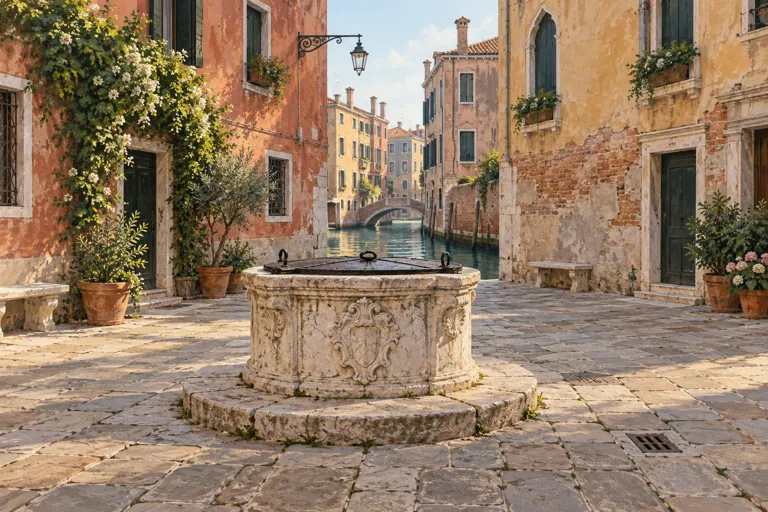
Take one question outside with you. Our guide to Venice’s wellheads and water collection offers a good example of how an ordinary-looking feature can open up a civic story. You can continue the museum’s work by paying attention in a campo, without turning every street into a formal lesson.
Choose three objects and make comparisons
A manageable independent visit might centre on one image, one object associated with public life and one object whose purpose initially puzzles you. Read the labels carefully, then explain each choice to someone else in your own words. If you are alone, write a single sentence. It quickly becomes apparent which details you have understood and which are still guesses.
Ask who could have used or seen each object, and what makes you think so. A material, inscription or stated provenance may support an answer; a lavish appearance alone does not tell you everything. The aim is not to solve an entire civilisation in an afternoon. It is to leave with a few precise observations that make the city more legible.
Check the ticket, especially for special routes
Consult the current visitor information before buying. The museum participates in the St Mark’s Square museum ticket arrangements, while the Royal Rooms are presented as a special guided itinerary. Check the exact included spaces and reservation conditions for your chosen ticket. A general description of the museum is not a promise that every room or temporary exhibition is included.
If you also plan to visit the palace, our Doge’s Palace introduction can help you give the two visits separate purposes. Leave time for security, entrances and a proper break. Trying to recover a ticket’s perceived value by hurrying through every possible room rarely improves the day.
Browse our Venice history experiences for a guided activity that fits the time you actually have. On a longer Italian itinerary, the Italy guide to reading civic squares continues this interest beyond Venice. The Correr is especially rewarding when its stories follow you back into the square and change what you notice there.
Sources & further reading
Turn a good read into a great day.
Find a highly rated Venetian experience that brings these stories to life.
Explore related experiences →