How Did Venice’s Maritime Republic Represent Its Power?

Venice represented maritime power through more than pictures of ships. Classical gods, ceremonial architecture and the winged lion helped turn trade and military ambition into a story about the republic itself. These images were persuasive choices, not neutral reports. Looking at them carefully lets you distinguish what a government wanted people to believe from the complicated history behind the claim. For a first encounter, follow three kinds of evidence: a pair of statues, a painted offering and a monumental gate.
Begin with the gods beside a staircase
In the Doge’s Palace courtyard, the Giants’ Staircase is guarded by Sansovino’s statues of Mars and Neptune. The museum’s courtyard guide identifies them with Venice’s power on land and sea. The pairing matters. A maritime republic could present itself as a force on the mainland too; the sea was central to its identity without being the whole of its political world.
Consider the location before concentrating on sculptural detail. Figures beside a ceremonial staircase participate in an encounter: someone approaches, moves upward and sees the institution frame that movement. The gods do not merely illustrate a textbook chapter. They give a setting an imposing historical and mythological vocabulary. Ask a guide what happened in the space, and distinguish that explanation from guessing solely from the statues’ size.
Watch the sea become a generous visitor
Tiepolo’s Neptune Offering the Riches of the Sea to Venice turns an economic relationship into a human drama. In the museum’s account of the painting, Venice appears as a richly dressed woman beside the lion, while Neptune presents a cornucopia. Pearls, coral, coins and jewels give the idea of maritime wealth a visible, graspable form.
The museum dates the painting to 1756–1758 and notes the distance between this confident imagery and the republic’s political and military weakness late in its history. That contrast is the useful lesson. A triumphant image may express an aspiration, preserve a prestigious memory or resist an uncomfortable present. It should not automatically be read as evidence that everything was going well when it was made.
You can apply a small looking exercise to any similar scene. Identify who receives, who gives and what lies between them. Then notice where your eye is directed by posture, light or color. Only afterward read the label. Your first observation will become something to test, rather than a conclusion you must defend.
Move from an image of wealth to a working institution
The Arsenale introduces a different scale of evidence. Its monumental land entrance belongs to a place associated with shipbuilding, and the city’s Castello naval-history itinerary explains how the gateway acquired additional commemorative meaning after the naval victory at Lepanto in 1571. A winged lion stands above its architectural composition. Practical infrastructure and public symbolism share the same threshold.
Do not reduce the entrance to an attractive collection of lions. Look at the way the portal marks a transition between city and institution. Then ask which features belong to its first construction and which were added later. You can investigate the exterior without assuming access to the working or exhibition areas beyond it. Internal opening arrangements and event access require their own current checks.
Keep the lion useful without making it a universal decoder
The winged lion of St Mark is a recurring Venetian symbol, but spotting one does not explain the entire object carrying it. A painting, gateway and civic ornament have different makers, dates, settings and audiences. Record those distinctions. A symbol becomes historically interesting when you connect it to a particular commission or location, rather than using it as a shortcut around context.
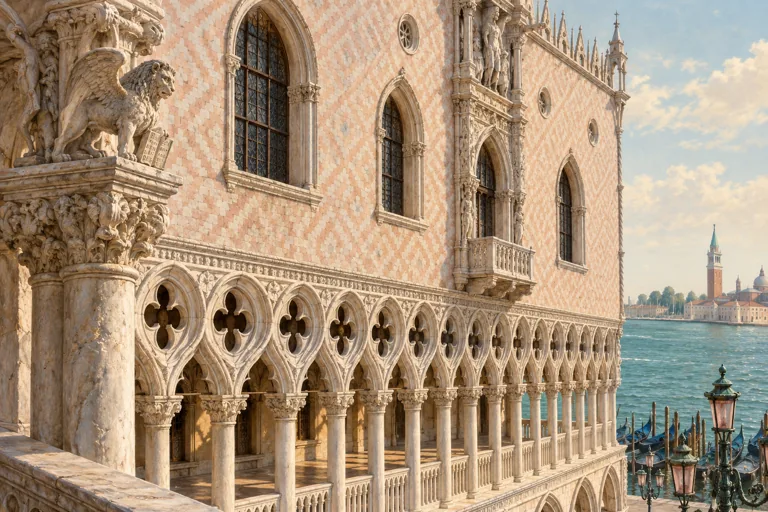
Our illustration is a contemporary symbolic composition, not a reproduction of a particular monument. During your visit, compare an actual object with its museum label or a reliable institutional description. Notice what remains uncertain. It is perfectly reasonable to leave a question open when a detail is too high to inspect or its history needs more research.
Build a visit around interpretation, not a victory parade
Choose one main encounter and give it enough time. Our introduction to the Doge’s Palace explains the governmental setting; the history experience collection helps you compare guided approaches. Read itineraries closely if a particular courtyard, gallery or room matters, because a general palace tour does not promise every possible route.
For a change of perspective afterward, use our Cannaregio walking guide to consider ordinary streets and shared spaces alongside official grandeur. The Venice day plans can help keep these different kinds of attention in balance. The most rewarding souvenir is a better question: whose version of Venice does this object present, and what would you need to learn to understand the people outside its frame?
For a useful comparison on a future Rome visit, read Colosseum Tour Hub’s guide to looking at the Arch of Constantine. The historical settings differ, but both visits reward asking who commissioned the imagery, whom it addressed and how older visual language was put to work.
Sources & further reading
Turn a good read into a great day.
Find a highly rated Venetian experience that brings these stories to life.
Explore related experiences →