Venice’s San Nicolò dei Mendicoli: how does restoration change what you see?

San Nicolò dei Mendicoli is a useful place to slow down your idea of an old Venetian church. A building can preserve early forms while carrying later decoration, repaired masonry and modern protection against water. Those layers do not cancel one another. They are the reason the church remains a place you can encounter, rather than an image in an architectural history book.
On a Dorsoduro walk, approach with two questions: what is the building asking you to notice, and what work has allowed that detail to survive? You do not need to identify every century by sight. A carefully observed doorway or a change from brick to gilded wood is a better beginning than a confident but unsupported date.
Begin with the building’s different scales
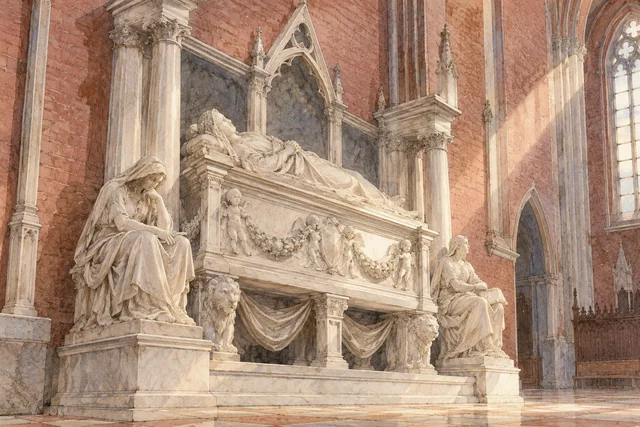
The conservation organisation Venice in Peril describes an early arrangement of nave, chancel screen, campanile and western porch, with substantial later additions. Its account identifies fourteenth-century capitals and a major campaign of gilded wooden decoration in the 1580s. That is enough chronology to make a first visit more interesting: the church is not a single moment preserved intact.
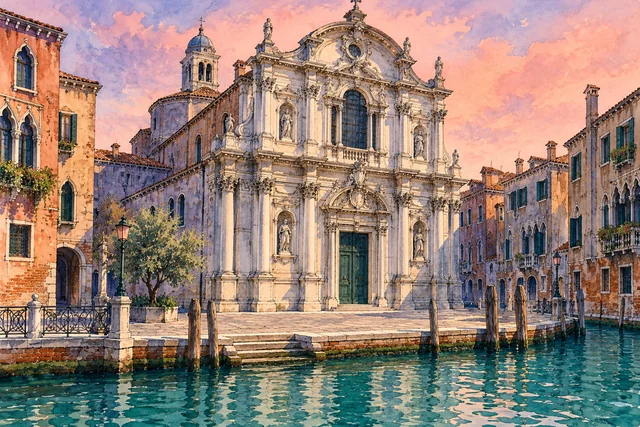
Outside, give the church and its surroundings time to form a whole. Where does the entrance draw your attention? How does the tower relate to the lower building? Which edges become clear when you take a few steps to one side? Keep to public space and avoid treating a doorway or a neighbour’s threshold as a viewing platform.
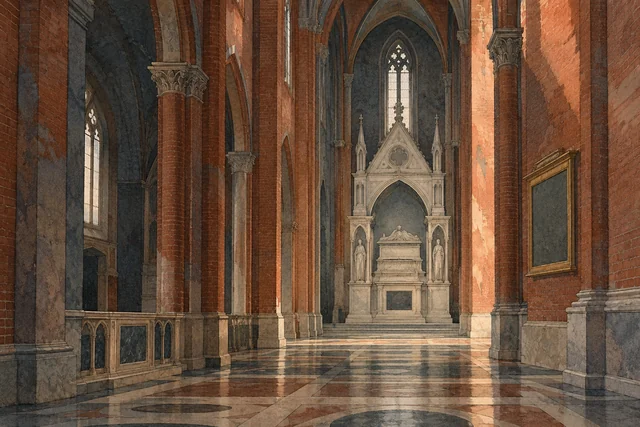
If the church is open for visitors, pause before moving towards individual works. Allow your eyes to adjust, then compare the scale of the room with the scale of its ornament. A carved detail might reward close looking, but its relationship with the larger space can disappear if you begin with your camera already zoomed in.
Read conservation as part of the story
Venice in Peril’s account of the 1972–1996 conservation programme includes structural work, protection beneath the paving, treatment of damp masonry, and conservation of the carved wood and iconostasis. The organ was restored and reinstalled. These interventions help explain why caring for a church involves both highly visible surfaces and systems that a visitor may never see.
Do not try to locate every repair from that account without an on-site explanation. A difference in colour is not, by itself, a date. Stone, brick and timber can vary for several reasons. Instead, use the history to ask a more productive question: which parts of a building need support, protection or maintenance before their decorative role can be appreciated?
A polished result can make labour disappear from view. Looking with conservation in mind brings it back. You may begin to notice that a church is simultaneously an architectural composition, a collection of materials and a place whose continued use requires everyday decisions. None of those perspectives needs to crowd out the others.
Keep water and weather in the present tense
The organisation also records flood-related work proposed after the exceptional water of 2019. A historical project description should not be read as a live works notice or a guarantee of present protection. For the day of your walk, use current municipal information and our guide to reading Venice’s tide forecasts rather than assuming that yesterday’s route will suit today.
Give yourself an alternative if conditions or church activities change. A short exterior study can still be worthwhile; it does not oblige you to wait at the door or interrupt worship. Keep bags close, leave circulation space and follow any instructions about photography. If step-free access or a particular entrance matters, confirm it directly before making the church the fixed point of your day.
Choose one comparison, not a church marathon
Our San Sebastiano guide offers another way to think about decoration as part of a church interior. The Scuola Grande dei Carmini provides a different setting for considering how painting and ornament work together. Check each venue independently; nearby on a map does not mean identical access arrangements.
For a later journey beyond Venice, Como’s San Carpoforo makes a useful comparison in separating an early building’s history from what remains visible now. The point is not to rank the churches by age. It is to become more precise about what a surviving building can, and cannot, tell you.
Our Venice experience collection can help you compare organised walks and their stated inclusions. A Dorsoduro itinerary should not be assumed to include this church or a special interior visit. Before leaving, choose one detail you could describe without a photograph: the balance of tower and roof, the transition into the nave, or the way carved wood changes your sense of the room. That small act of attention is a satisfying return for a slower visit.
Sources & further reading
Turn a good read into a great day.
Find a highly rated Venetian experience that brings these stories to life.
Explore related experiences →