Venice’s San Giovanni in Bragora: how can one altarpiece reward a slower visit?

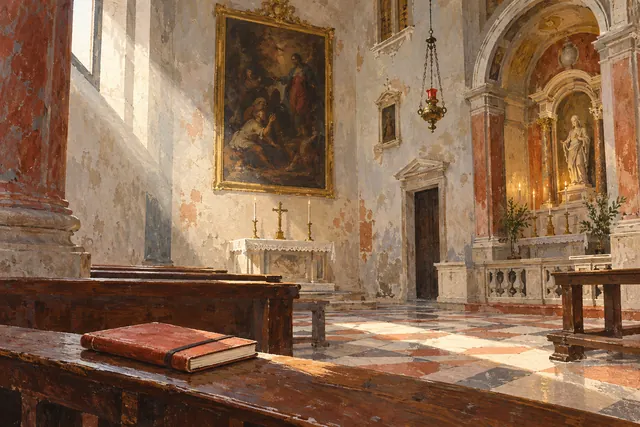
At San Giovanni in Bragora, one painting can give a Venice church visit its centre of gravity. Cima da Conegliano’s Baptism of Christ belongs to the high altar, so the encounter is about more than recognising an artist. It invites you to consider how an image, a church’s dedication and the space used for worship work together. Give that relationship time, and a short visit can feel remarkably complete.
The church stands in Castello, on the campo identified by Chorus as Campo della Bragora. Plan it as a particular stop, with time to enter quietly and understand the space. It need not become the first item in an ambitious church marathon. The most useful question is specific: what does this altarpiece do here that a reproduction on a screen cannot show?
Why does the high altar matter?
The Chorus account of San Giovanni in Bragora identifies Cima’s painting as one of the older Venetian high-altarpieces still preserved in its original church position. It also describes the presbytery, dominated by the painting, as the building’s architectural focus despite later changes. That combination gives you a starting point: look at the work as part of a place, rather than mentally lifting it out of the room.
“In its original position” does not mean the surrounding church has remained untouched. Keep continuity and change in view together. The important opportunity is to consider the painting’s relationship with the high altar; it is not permission to imagine that every surface, lighting condition or visitor viewpoint reproduces the fifteenth century.
From a permitted place in the church, notice how the space directs attention towards the altar. Then look away briefly and return to the painting. Does it gather the room together? This is an interpretation to test through your own experience, not a claim that every person must respond in the same way. A busy service and a quiet sightseeing period can produce very different encounters.
What connects the subject to the church?
Chorus’s entry for the Baptism explains that the image depicts the church’s titular saint, John the Baptist, in the episode of Christ’s baptism described in Matthew’s Gospel. The subject therefore has a particular relationship to this dedication. It is not merely a convenient religious scene selected to fill a large frame.
Start with the action linking the two principal figures, rather than trying to decode every detail immediately. What makes the event legible? What role do gesture and the space between figures play? Once you have identified that relationship, let your attention move into the surrounding painted world. Compare the concentrated action with the larger setting, then return to the action again.
Allow unfamiliar symbolism to remain a question until you have a reliable explanation. A landscape feature is not automatically a coded message, and an appealing resemblance to somewhere you visited is not proof of a precise location. You can enjoy the painting’s setting without turning every hill or tree into a confident identification.
What changes when you include the room?
Use two views, where access permits: one that includes the altar and surrounding architecture, and another that gives the painting more of your attention. The first shows relationships; the second helps you follow the scene. Neither is automatically the “correct” view. Resist moving beyond barriers to improve a photograph or obtain a closer look.
Our article on looking closely at Venetian painting supplies a broader set of observation questions. At Bragora, keep bringing those questions back to the altar. Scale, placement and religious use are the distinctive ingredients of this visit. A photograph cropped to the painted rectangle can help you recall details afterward, but it removes much of that setting.
For a productive contrast on another day, consider San Giobbe and the movement of paintings out of churches. Bragora lets you ask what an enduring location preserves; San Giobbe raises questions about what happens when a work’s surroundings change. You do not have to visit both in one afternoon to make the comparison useful.
How can you make the visit practical?
Check the current Chorus church map and the church’s visitor notices before setting out. Confirm arrangements for artistic visiting, any contribution required for a particular space and restrictions during religious celebrations. Do not borrow another Chorus church’s arrangements and assume that they apply here. If seeing the altarpiece is essential to your plans, ask whether it is currently visible.
Keep voices low, follow photography instructions and give worshippers room. If a service prevents the visit you intended, use the campo as a pause and return at an appropriate time. Our Castello neighbourhood guide helps you connect the stop to a modest walk, while our Venice arts experiences let you compare guided options by their actual venues and subjects.
If your journey continues to Florence, Santa Maria Novella provides another occasion to consider art within a religious building. At Bragora, finish with one sentence of your own: what became clearer because you saw Cima’s painting in relation to the altar? That answer is a useful souvenir, and considerably lighter than another guidebook.
Sources & further reading
Turn a good read into a great day.
Find a highly rated Venetian experience that brings these stories to life.
Explore related experiences →