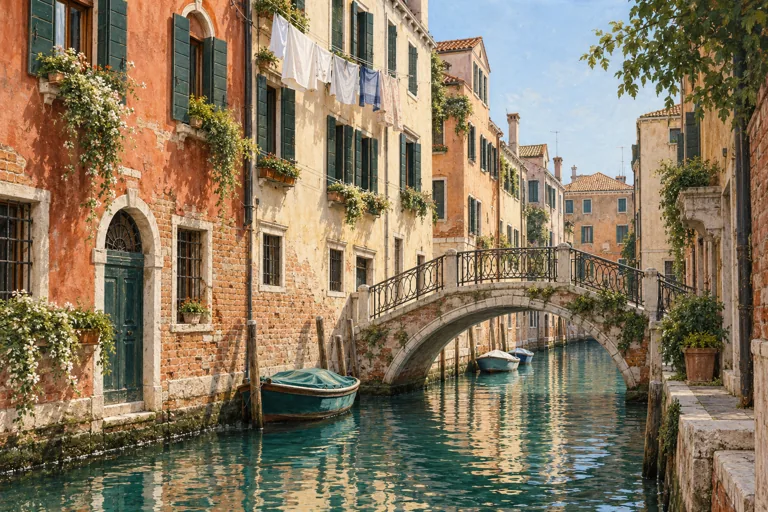
Castello on foot: shipbuilding stories and neighborhood details

Castello offers a way to think about Venice through work as well as beauty. Boats had to be built, repaired, supplied and moved; a maritime city needed much more than an impressive waterfront. A walk shaped around the Arsenale’s public exterior and the surrounding neighborhood can make that practical history visible. The aim is not to imagine every quiet doorway as a secret workshop. It is to notice how water, walls and pedestrian spaces organise the district you can actually see.
Give the walk a modest boundary. Choose a starting point that suits your accommodation or arrival stop, one main historical focus and a clear way back. Castello is not a single small attraction, and a route that looks compact on a screen can include more bridge crossings than expected. Our waterbus planning guide helps you compare a walking return with a public-transport option before fatigue makes the decision for you.
Begin with the idea of a working maritime city
The municipality’s Arsenale chronology describes a complex where ships, weapons, raw materials, ropes, sails and oars formed part of a coordinated system. That is the useful starting point: a vessel was the result of many different materials and skills. You can carry this idea into the walk without pretending that the present-day district preserves every stage of that work unchanged.
Look for the contrast between spaces made for walking and spaces organised around water. A canal can be a view for you and a working route for someone else. Keep clear of landing places and do not stop where deliveries are being handled. The difference between admiring a place and obstructing it is often only a few steps sideways.
Use the Arsenale exterior as a reading point
At a permitted public viewpoint near the monumental entrance and water gate, look at how masonry controls the boundary between city and complex. What is revealed, and what remains out of sight? The city’s historical account connects the Arsenale’s early development with Venice’s expanding shipbuilding needs. It also cautions that the conventional foundation date of 1104 should not be treated as a securely established beginning. That small qualification is a useful defence against an overly tidy story.
Do not assume that seeing an entrance means you may walk through it. Parts of the Arsenale have different uses and access arrangements, and exhibition or event admission is separate from an ordinary neighborhood walk. Check the relevant official operator for any interior visit. A public exterior stop can still be rewarding when treated as a boundary to understand rather than a doorway you have failed to pass.
Follow a theme, not a borrowed marathon
Venezia Unica’s Castello itinerary brings naval history into conversation with churches, craft traditions and neighborhood spaces. Use it to select a manageable section rather than assuming its entire route belongs in one outing. If one church or museum particularly interests you, check its current opening arrangements and make that the planned interior stop. Leave the rest as optional observations.
Our article on the maritime republic’s public image offers a complementary question: how did a city represent the power that all this work helped support? You might compare a formal gateway with a more ordinary stretch of canal. One announces authority; the other can reveal something about the practical demands of moving through the city. Let the comparison remain grounded in what is visible and documented.
Give small details enough room
A useful neighborhood exercise is to choose three details of different scales: a large wall or gateway, the arrangement of a campo, and a small feature such as a threshold or mooring point. Describe them before reaching for a historical explanation. This keeps the walk interesting even when an intended interior is closed. It also prevents every attractive object from acquiring a story merely because a story would sound good.
Avoid photographing people at work as if they were part of an exhibition. Ask before entering a workshop or taking close photographs inside, and treat purchases and demonstrations according to the business’s own arrangements. If craft interests you across Italy, Florence Tour Hub’s Oltrarno walk offers a useful comparison with another urban setting where visitors and working life share space.
Make the route fit your group
Check the official accessibility information when bridge steps or uneven surfaces affect anyone in your party. “A short walk” is not the same as a suitable route. Build in a seated stop and an easy decision point where you can turn back. Our respectful Venice guide adds practical habits for sharing narrow streets.
If you would like a guide to connect the district’s historical themes, compare Venice walking experiences and check their precise routes and access claims. Castello is most rewarding when you leave with a clearer sense of how a city worked, rather than a longer list of doors you hurried past.
Sources & further reading
Turn a good read into a great day.
Find a highly rated Venetian experience that brings these stories to life.
Explore related experiences →