Venice’s San Polo: how do you follow a painted sequence in the oratory?

A painted sequence asks for a different kind of attention from a single famous picture. At Venice’s church of San Polo, the Oratory of the Crucifixion offers a chance to follow connected scenes without treating each frame as a separate stop on a checklist. Begin with the room, then the sequence, then one detail. That order can make a compact visit feel more coherent than racing between artists’ names.
Find the oratory within the church
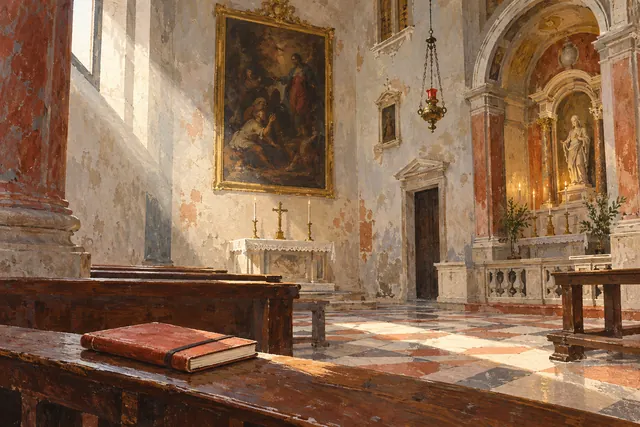
The church’s official Chorus description identifies fourteen Stations of the Cross by Giandomenico Tiepolo, dated 1749–1750, in the eighteenth-century oratory behind the main facade. The artist is the son of Giambattista Tiepolo. Keeping those names distinct matters here: the church also contains work by the father, and a familiar surname should not erase the difference between two painters.
Once inside, establish the actual route and any areas unavailable that day. Look at how the paintings occupy the space before moving close to an individual work. Their relationship to the room matters because a sequence is encountered through movement and changing attention. Follow the displayed order and any staff guidance; do not assume the nearest frame is necessarily the beginning.
Notice what continues from one scene to the next
Choose two neighbouring scenes and ask what changes. A repeated figure, an item of clothing, the position of a cross or the direction of a gesture may help you follow the narrative. Describe the visible connection before trying to explain its emotional effect. This gives your interpretation something concrete to rest on and keeps you from merely repeating the title beneath the picture.
Then ask what the painter has chosen to show at that particular moment. A gesture can hold the attention while a larger event remains implied. Look for the balance between the central action and surrounding witnesses. You do not have to recognise everyone to notice whether a group closes in, leaves space or directs your eye towards another figure. Let the work supply the evidence for the question.
Give one painting a second visit
After following part of the sequence, return to the scene that first held your attention. Does it feel different now that you have seen what precedes or follows it? A picture that initially seemed crowded might become easier to read once a repeated figure is familiar. Alternatively, a small gesture might become more striking because it differs from those in neighbouring scenes.
This second look is a practical alternative to trying to memorise the whole cycle. If you are visiting with someone else, each choose one detail and explain why you noticed it. Keep voices low and discussions brief in the sacred space; continue a longer conversation outside. The point is to practise attentive looking, not to conduct a seminar across another visitor’s view.
Keep devotion and art viewing in the same frame
The Stations of the Cross belong to a devotional tradition concerning Christ’s Passion. The paintings can be approached through composition and technique while respecting that religious purpose. A visitor interested mainly in art should still respond to worship taking place and follow the church’s instructions on conduct and photography. Do not move furnishings, cross barriers or use a camera to claim a position another person needs.
The larger church contains other works, including Tintoretto’s Last Supper, according to Chorus. You may prefer to choose one additional painting after the oratory rather than attempting a complete inventory. Our guide to looking closely at Venetian painting offers a simple method for that slower encounter.
Use the artistic-visiting hours
Checked on 4 November 2026, Chorus lists artistic visits Monday to Saturday, 10:30–13:30 and 14:30–17:00, with last admission ten minutes before closing. Services have a separate timetable. Recheck the official page before departure, and establish the ticket option and current access arrangements for the visit you intend. A service time is not a substitute for an art-visiting session.
The midday break matters when putting the stop into a wider route. Allow time to locate the entrance, enter and orient yourself before beginning the paintings. If steps, standing time or a particular route could be difficult, contact the operator with those needs rather than relying on the church’s size as a guide to accessibility. A small building can still require specific planning.
Choose a comparison that adds something
Our San Rocco guide considers a larger painted environment, while the Carmini article looks at painting in relation to decoration. They are separate institutions with separate access arrangements. For another city’s narrative setting, Florence’s San Salvi refectory guide asks how a painted meal relates to an actual room. Explore Venice arts experiences by their real itineraries. At San Polo, a successful visit might be measured by one sequence you can follow and one painting you want to see again.
Sources & further reading
Turn a good read into a great day.
Find a highly rated Venetian experience that brings these stories to life.
Explore related experiences →