Venice’s San Giobbe: what changes when paintings move away from a church?

A church can remain rich in art while some of its most famous paintings are elsewhere. San Giobbe, in Venice’s Cannaregio district, is a rewarding place to think about that apparent contradiction. The visit is not a treasure hunt in which a missing name means disappointment. It is an opportunity to distinguish the architecture that shaped a work’s first setting from the museum setting in which that work may now be studied.
Give the building its own history
Chorus Venezia traces the church’s origins to a hospice and oratory founded by Giovanni Contarini in 1378. Later Franciscan building and fifteenth-century patronage changed the site. Doge Cristoforo Moro supported its Renaissance transformation, and the church was reconsecrated in 1493 with a dedication to both Job and Bernardino of Siena. The building therefore developed through successive purposes and patrons.
Begin with the space rather than immediately searching for a particular painter. Notice how an arch frames the area beyond it and how decoration directs attention. You can make these observations without deciding what every earlier stage looked like. A surviving church is evidence of change, not an invitation to mentally remove all the inconvenient later layers.
Understand where the famous paintings belong today
Chorus distinguishes works still associated with the church from major paintings by Bellini, Carpaccio and Basaiti transferred to the Gallerie dell’Accademia. The University of Bologna’s Fondazione Zeri catalogue identifies Bellini’s San Giobbe altarpiece with its present Accademia location and former church setting. Do not arrive expecting that painting to be hanging in San Giobbe.
That movement creates a useful two-part question. What can the church tell you about scale, distance and devotional setting? What can the museum tell you through close viewing, comparison and interpretation? Neither encounter automatically supplies the other. If you visit both, keep their tickets and opening arrangements separate, and allow time to travel between them.
Read an absence carefully
It is tempting to imagine a displaced painting returning neatly to a blank space in front of you. Check the documentation before doing so. Buildings can be altered after a work leaves, and present lighting or furnishings may differ substantially from the original setting. A reconstruction should be identified as a reconstruction, with its assumptions visible.
Instead, try a smaller exercise. Consider how the shape and size of an altarpiece would relate to a chapel or architectural frame, then compare that question with the museum’s explanation. You do not need to claim an exact historical view. Recognising the limits of the comparison is part of understanding why location matters to the meaning of art.
Notice what the church still offers
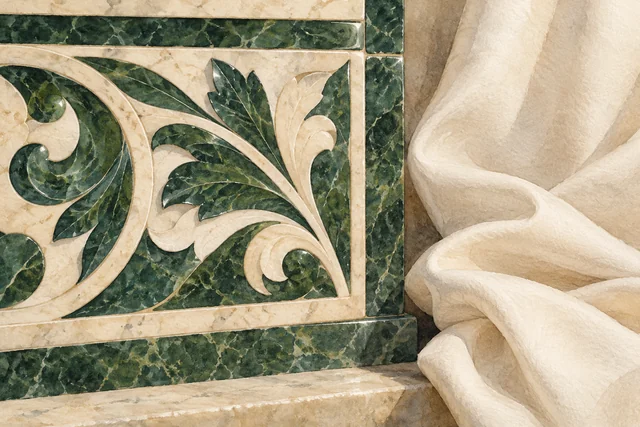
Chorus highlights Pietro Lombardo’s architectural work and the Martini Chapel’s glazed ceramic ceiling, attributed to Luca della Robbia. Preserve that word “attributed”: it conveys the status of the identification. Look at how a coloured, reflective surface behaves differently from surrounding stone or plaster. That material comparison can be enjoyable without pretending that all parts of the church belong to one workshop.
The church also retains paintings and furnishings with their own histories. Read the current labels and ask staff about any area that is not accessible. Our Santa Maria dei Miracoli article offers another approach to architectural detail, while Palazzo Grimani explores the relationship between collection and setting. These comparisons should deepen a visit, not turn it into a race between names.
Use the limited visiting window well
As checked on 26 October 2026, Chorus lists artistic visits on Monday, Tuesday, Friday and Saturday from 10:30 to 13:00, with last entry ten minutes before closing. Times for worship are listed separately. A church being open for a service is not the same as permission to tour it, and liturgical needs take priority over sightseeing.
For Bellini at the Accademia, check the museum’s current notices and information about works temporarily unavailable or under restoration. Its recent restoration programme for the San Giobbe altarpiece is a reason to verify viewing conditions, not a guarantee of an unobstructed display or a bookable conservation visit on your date.
Our Frari guide adds another perspective on art and remembrance in a living church. Browse Venice arts experiences for carefully described routes. Florence’s Orsanmichele article provides a further comparison between originals and their settings. Leave San Giobbe with a clearer distinction between where an artwork began, where it is now and what each place can still explain.
Sources & further reading
Turn a good read into a great day.
Find a highly rated Venetian experience that brings these stories to life.
Explore related experiences →