Venice’s San Lio: what can a small church reveal beyond its entrance?

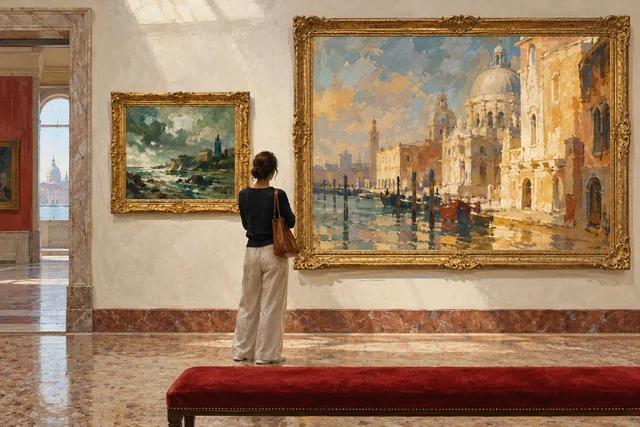
A small church can ask a great deal of your attention without demanding a long itinerary. At San Lio in Venice’s Castello district, the useful question is not how many famous names you can collect. It is how a compact interior brings architecture, paintings, memorials and current religious use into the same field of vision. Give the room a chance to make that relationship visible.
Start in Campo San Lio and check the church notice before entering. A route through Venice may carry you past a doorway almost without noticing it. Turning that passing moment into a deliberate visit requires very little equipment: enough time to stop, a current access check and permission to leave some details unexplained.
Check the current artistic-visit arrangement
When checked on 1 November 2026, Chorus lists artistic visiting hours for San Lio from Monday to Saturday, 10:30–17:00, with last entry ten minutes before closing. Its network guidance states that church access is free, while some internal areas require a contribution. Confirm the notice for the particular space you want to see; free church entry does not establish access to every chapel or activity.
Today’s date is a Sunday, so do not transfer that weekday-and-Saturday timetable to a Sunday visit. Celebrations have their own arrangements, and a service is not an artistic visiting session. If worship is under way, let it determine your behaviour and whether this is the right moment to remain. A closed door is a reason to adjust the walk, not a puzzle to solve through another entrance.
Let the room complicate the word “old”
Chorus describes an earlier three-aisled building transformed into a single nave in the eighteenth century. Its account connects the name San Lio with Saint Leo and the church’s earlier dedication to Saint Catherine. For the visitor, the important result is that a long history does not mean a visually unchanged interior.
Stand where you can see the main axis without blocking the entrance. Notice how your attention is directed forward and where it is drawn sideways. Then move only as far as the permitted route allows. A single nave can still contain several competing centres of attention; your task is to recognise them, not to hurry between them as though completing a checklist.
This is also a useful exercise in distinguishing description from interpretation. You can say that a framed work draws your eye because of its light or position. You need a reliable label or source before turning that response into a claim about why the patron commissioned it. Looking becomes richer when those two kinds of statement remain separate.
Choose a chapel and a painting as different encounters
The operator identifies the Gussoni Chapel with Pietro Lombardo and its marble altarpiece with Tullio Lombardo. It also identifies a Saint James by Titian and a ceiling fresco by Giandomenico Tiepolo. Those names offer points of orientation, not a requirement to inspect everything. Use the current on-site interpretation to establish which work you are looking at.
A chapel can be approached as a small architectural setting. Look at the relationship between its opening and the room around it, then consider how the object inside is framed. For a painting, begin with the figure, the space and the direction of light. Comparing those encounters is more useful than expecting marble relief and painted surface to produce the same effect.
Keep your viewing physically comfortable. Looking upward for a long time can quickly turn attention into fatigue. Step aside, lower your gaze and return to the room before trying another detail. Never lean against a monument or use church furnishings to obtain a better photograph. Quiet looking is an activity, even when it produces no picture to take home.
Build a small, coherent continuation
Our Santa Maria dei Miracoli guide develops the question of marble in a compact church. Santi Giovanni e Paolo offers a larger setting for thinking about monuments and remembrance. You can read either before the trip without committing yourself to visiting both on the same day.
If paintings become your main interest, our Gallerie dell’Accademia guide suggests ways to avoid visual overload. On a separate Milan visit, San Satiro invites a related discussion of how architecture shapes the impression of space. These comparisons should sharpen observation, rather than encourage a claim that the buildings work in identical ways.
Compare guided outings through our Venice experience collection, reading the actual route, meeting point and admission terms. A walking tour through Castello does not automatically include San Lio or a reserved chapel visit. The reward of this stop can be modest and memorable: a clearer understanding of one room, and the discovery that a doorway passed in seconds can open into a much slower way of seeing Venice.
Sources & further reading
Turn a good read into a great day.
Find a highly rated Venetian experience that brings these stories to life.
Explore related experiences →