Venice’s Santi Giovanni e Paolo: how do ducal tombs turn a church into public memory?

At Santi Giovanni e Paolo, a Venetian church becomes a place to think about how political lives are remembered. The ducal monuments are not simply a row of historical portraits. Their scale, placement and sculptural language shape what a visitor is invited to notice. You can learn a great deal by comparing two monuments carefully, without trying to turn a church visit into a complete chronological survey of the Venetian Republic.
Begin with the church as a whole
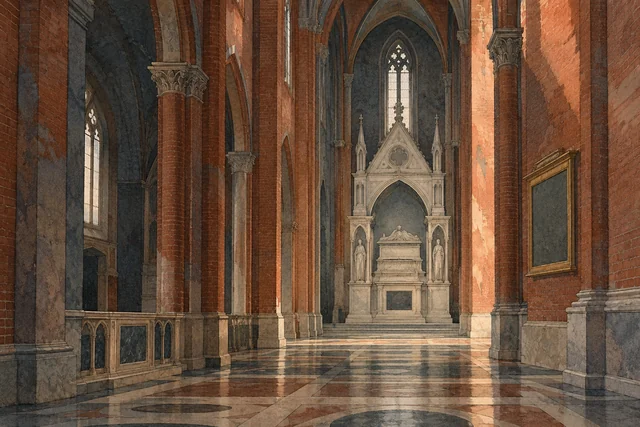
Look along the interior before reading an individual name. Notice how a monument relates to an aisle, a wall, a chapel or the entrance. Is it encountered immediately, or does it require you to turn and look upward? These relationships are part of the experience of commemoration. A tomb that occupies a prominent architectural position makes a different impression from a small inscription underfoot.
The basilica’s own art guide counts thirty-seven funerary monuments, twenty-five dedicated to doges, as well as at least one hundred and fifty floor tombstones. Those figures explain the richness of the setting, but they are not a challenge to find everything. The number of monuments and the number of people actually buried are also different questions; avoid treating a dedication as proof of the precise contents of a tomb.
Compare two monuments, not twenty-five biographies
Choose a pair identified by the church’s interpretation, perhaps a Mocenigo monument and the Valier family monument. Begin with their visible organisation. How many figures appear? Which gestures, materials or architectural forms direct attention? Does the design present a single person, a family relationship or a broader statement of status? Let the label supply the names and dates while your eyes supply the comparison.
You need not know every sculptor to notice differences in scale and emphasis. A useful exercise is to describe each monument in one sentence without using the word grand. That forces you to say what is actually there: a raised figure, a strongly framed central zone, a repeated emblem or an arrangement that draws the eye upward. Specific description gives historical interpretation a firmer foundation.
Remember that commemoration selects
A funerary monument is not a neutral summary of a political career. Its commissioners and makers chose what to emphasise, and the resulting image cannot tell you everything about a doge’s government or the people affected by it. This is an interpretive caution, rather than an accusation against a particular monument. Public memory is often shaped by what is made visible and what is left outside the frame.
If a label identifies a virtue, an allegorical figure or a victory, ask how the imagery makes that claim persuasive. Then keep the commemorative statement separate from a fuller historical assessment. A church can preserve important evidence about political culture without supplying the whole political story. That distinction makes the visit more interesting, not less respectful.
Look down as well as up
The larger monuments naturally attract attention, but the floor also carries traces of memorial use. Observe permitted areas without kneeling in circulation routes, touching surfaces or attempting rubbings. A worn inscription may be difficult to decipher because of both its age and its position in a building used over time. Wear itself can prompt a question about how commemoration and ordinary movement coexist.
Do not assume every visible element belongs to the same period. A church accumulates alterations, furnishings and acts of remembrance. The relationship between a monument and its present surroundings may therefore need explanation. When uncertain, consult the basilica’s guide or ask a focused question about the work in front of you rather than constructing a chronology from appearance alone.
Use sightseeing hours, not simply open-door hours
The current official schedule checked on 29 October 2026 lists tourist visits Monday to Saturday from 09:00 to 17:45 and on Sundays and holy days from 12:00 to 17:45. Prayer and celebration schedules are separate, and special days can alter access. Recheck before travelling and follow notices on arrival. An open door during worship is not an invitation to continue an architectural tour around a service.
For context, compare our Frari guide, the account of Venice as a maritime republic, and the nearby Scuola Grande di San Marco. Browse Venice history experiences for their precise stops. Rome’s Non-Catholic Cemetery guide offers another way to approach memorial places respectfully. Leave with two monuments you can describe and one question about the stories they choose to tell.
Sources & further reading
Turn a good read into a great day.
Find a highly rated Venetian experience that brings these stories to life.
Explore related experiences →