Venice’s San Stae: what changes when a church faces the Grand Canal?

San Stae asks you to think about an arrival before an entrance. Its facade faces the Grand Canal, so the approach belongs to a city in which water has long acted as a principal street. You can begin the visit outside, noticing how the church addresses that open space. An interior visit may add another layer, but it should be planned separately rather than assumed from an attractive photograph of the facade.
Use the full name to orient yourself
San Stae is the Venetian form of Sant’Eustachio. The church stands by its namesake campo and waterbus stop, but the stop’s name does not establish which route is useful for your journey on a particular day. Check the current transport information, then give yourself time to step clear of the landing before looking. A working arrival point should remain usable for residents and other passengers.
The official descriptions identify the facade as a design by Domenico Rossi from 1709. Look first at its broad divisions, then at the stone ornament that makes those divisions lively. From a safe position in the public space, compare areas of projection and shadow. You do not need to identify every sculpted figure to notice that the facade was designed to be read both as a whole and in smaller episodes.
A watery approach changes the encounter
Imagine two views without claiming to reconstruct a historical ceremony: a glimpse while moving along the canal, and a stationary view from the campo. Which elements remain legible at a distance? Which details only become interesting when you stop? This simple comparison helps explain why a facade can work at more than one scale. It also gives you a reason to look with your eyes before deciding what belongs in a photograph.
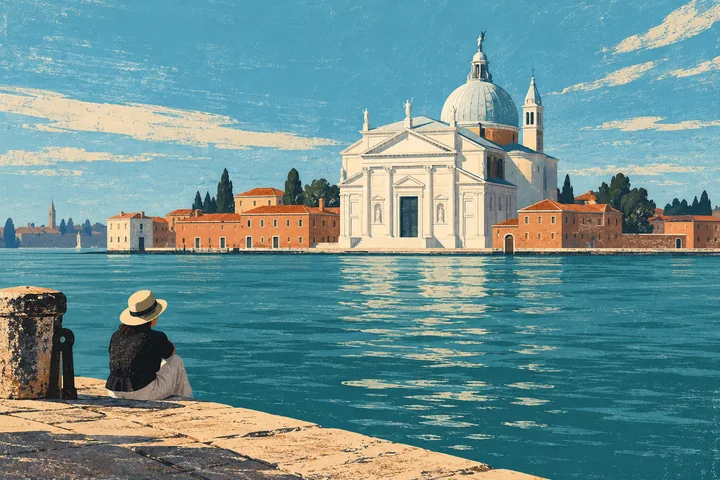
Our Redentore article considers a different waterfront relationship. Use it as a comparison of setting, not an assertion that the two buildings share a single purpose or design. The Santa Maria dei Miracoli guide changes the question again, towards the organisation of a smaller marble church. Venice becomes more interesting when similarities lead to precise differences.
If the interior is open, change your pace
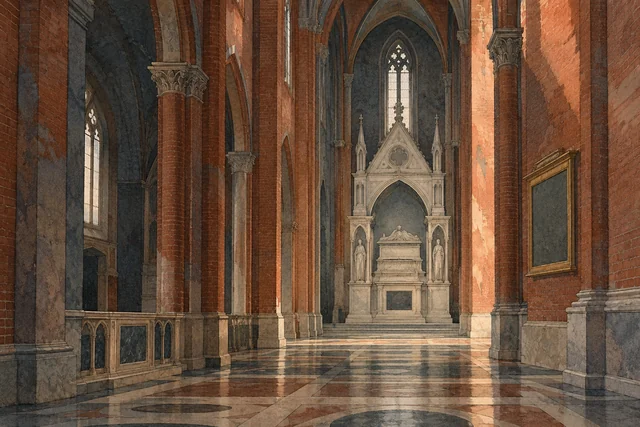
Chorus describes a single nave with three chapels on each side and a prominent Mocenigo family tomb marker. That gives you an initial framework, not a command to inspect every chapel. Let the room’s structure become clear before choosing one work. The scale of an interior often feels different from the promise of a richly ornamented exterior, and noticing that change is part of the visit.
The church’s paintings include works by Tiepolo, Piazzetta and Sebastiano Ricci. Rather than collecting names, compare one visible gesture or contrast of light across two works, using labels to establish subjects and authorship. Do not infer that every work mentioned on a website is visible from every visitor position. A closed space, a barrier or a service may limit the route, and staff instructions take priority over a planned checklist.
Check access directly: official schedules disagree
As checked on 24 October 2026, Venezia Unica lists a narrow Wednesday-and-Thursday afternoon opening, while the Chorus church page displays a broader Monday-to-Saturday schedule. These are conflicting official statements, not two complementary time bands to combine. Confirm the specific day directly before making the interior your main reason for travelling here. If confirmation is unavailable, plan an exterior stop and choose a separately verified indoor alternative.
Venezia Unica also notes that liturgical celebrations or operational needs can temporarily restrict entry. Free admission, where offered, does not guarantee an unrestricted visit to every room. Keep worship and art viewing distinct, follow current photography instructions and avoid disturbing anyone at prayer. This is especially important when a short opening window tempts visitors to hurry through the space as if time alone justified ignoring its purpose.
Leave with one useful observation
For a broader account of the city beyond individual churches, our Museo Correr guide can help connect an architectural visit with civic history. Compare Venice history experiences if you prefer guided context, checking whether San Stae is an actual stop and whether interior access is promised. A route past a church and admission to it are different inclusions.
If Florence is another stop, Florence Tour Hub’s Santa Maria Novella guide offers a contrasting church approach in a land-based urban square. At San Stae, the most useful souvenir may be a single observation about distance: what you could read from the water, what appeared only in the campo, and what remained a question until you could enter.
Sources & further reading
Turn a good read into a great day.
Find a highly rated Venetian experience that brings these stories to life.
Explore related experiences →