Venice’s San Zaccaria: how do you distinguish church, museum and crypt?

San Zaccaria rewards a visitor who slows down after leaving the waterfront. The useful distinction is between entering a living church and choosing its museum-and-crypt route. They belong to the same larger place, but they offer different encounters and may have different access arrangements. Decide whether you want a brief respectful church visit or time to study the older spaces and works included in the museum route.
Begin with the right kind of visit
The Chorus operator’s page describes the Museum and Crypt of San Zaccaria and lists it within the Chorus Pass. Do not assume that a general church opening notice guarantees entry to every room or the crypt. Confirm the current route, ticket conditions and last entry directly with the operator for your chosen date.
When researched on 16 October 2026, official visitor pages were not fully consistent about Sunday opening. That is a reason to check directly, rather than to choose whichever timetable best suits your plans. Religious use and temporary limitations can also affect the encounter. A small amount of preparation is preferable to building an entire afternoon around an unconfirmed slot.
Let the older spaces change your sense of the building
Chorus identifies the Chapel of Saint Tarasius as the former Gothic presbytery. That description matters: a room seen within today’s route once occupied a different relationship to the church as a whole. Instead of assuming that the present circulation is timeless, ask how a change in scale, ceiling or decoration signals an earlier arrangement.
You do not have to reconstruct every phase to notice that a building can contain different spatial histories. Our Castello walking guide offers a broader neighborhood setting. Keep San Zaccaria as a focused stop within that walk, rather than trying to force every nearby church and museum into the same afternoon.
Look at a painted ensemble before isolating a detail
The operator describes fifteenth-century polyptychs by Antonio Vivarini and Giovanni d’Alemagna, with carved wooden framing by Ludovico da Forlì. A polyptych is an ensemble of panels: the arrangement and frame help organize how the parts are encountered. Start by looking at that structure before concentrating on one face or costume.
Notice where the frame divides the images and where a repeated color or gesture encourages comparison. Read the labels for the identities and subjects; visual resemblance alone is not enough to name a saint. Our guide to looking at Venetian painting suggests a useful rhythm: observe first, check the interpretation, then return to the image with a more precise question.
Treat the crypt’s water as a condition, not a performance
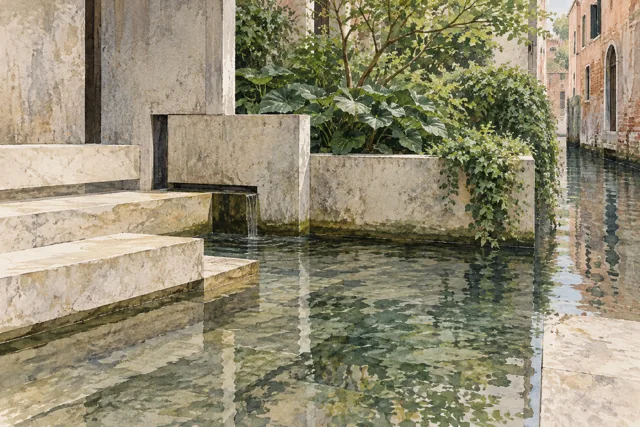
The official account describes the crypt as often affected by tidal water. Reflections may be visually striking, but photographs of water do not establish the conditions you will find on arrival. A dry, wet, restricted or temporarily inaccessible area calls for different visitor behavior. Follow the current route and staff instructions rather than stepping beyond a barrier to reproduce a familiar image.
Our tide-forecast guide explains why local conditions and official advice matter across Venice. A forecast for the city is not a guarantee about a particular interior. If steps, narrow passages or water affect your mobility needs, ask the venue about the exact route before purchasing or committing to the visit.
Keep attention on the actual objects and rooms
A small museum route can be more rewarding when you give each space a clear question. In a decorated chapel, ask how painting and framing work together. In a crypt, ask how columns and vaults divide the room. In a former choir, consider how its original use differs from the way visitors move through it today. These questions do not require a dramatic story about secrets or hidden Venice.
Resist treating age as the only measure of interest. A later intervention, a conservation decision or a changed display may explain what you can see as much as an original date does. In Rome, San Clemente offers another way to think about layered religious buildings, while remaining a different site with its own evidence and access conditions.
Leave room for the church and the neighborhood
Speak quietly, follow photography rules and allow worshippers and other visitors space. The paid cultural route does not turn the whole building into a set for photographs. If you want guided interpretation, check whether San Zaccaria is specifically named in Venice’s cultural experience collection; a general Castello walk may or may not include the museum and crypt.
Finish by returning to the neighborhood at an unhurried pace. You might remember the arrangement of a painted ensemble, a change in architectural scale or the way reflected light altered a vault. A successful visit does not require every room to be open or every surface to look as it did in a promotional image. It requires knowing what you actually encountered and giving it thoughtful attention.
Sources & further reading
Turn a good read into a great day.
Find a highly rated Venetian experience that brings these stories to life.
Explore related experiences →