Ca’ Pesaro in Venice: how should you approach its modern art?

Ca’ Pesaro is a useful reminder that Venice’s artistic life did not stop with the great painters of the Republic. Its International Gallery of Modern Art places later experiments within a historic palace, creating a visit with two scales of interest: individual works and the setting around them. Rather than arriving with a checklist of famous names, choose a question about form, material or the body and see how different artists answer it.
Begin with the collection’s purpose
The museum’s official guide connects the gallery’s formation with the palace bequest of Felicita Bevilacqua La Masa and acquisitions associated with the early Venice Biennales. That history helps explain why this is not simply an old palace filled with furniture from its original occupants. The museum’s identity also belongs to the changing institutions of modern art.
Look at the room before choosing a work. How does the scale of the architecture affect your first impression? Does an object seem intimate, monumental or surprisingly vulnerable within it? Keep this as your own response rather than a claim about the artist’s intention. Our Ca’ Rezzonico guide offers a different relationship between palace and collection; comparing the questions each museum asks is more useful than assuming all Venetian palaces offer the same experience.
Give sculpture room to change
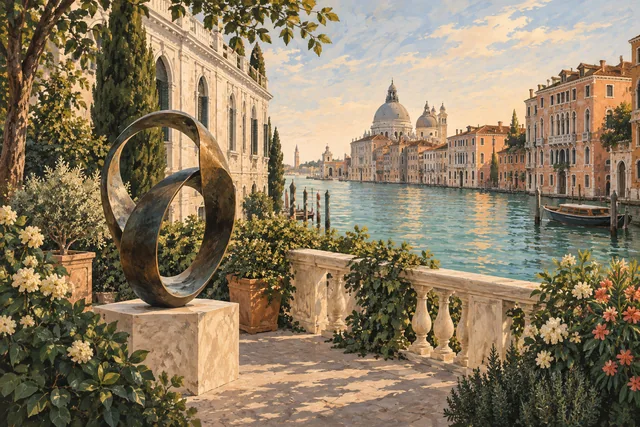
Sculpture is an important part of Ca’ Pesaro’s collection. Choose one work on the available route and observe it from more than one permitted position. A silhouette can change dramatically after a few steps. A hollow, projection or surface that seemed minor from the front may become the feature that organizes the whole object from the side.
Notice how light behaves on the material. Does a smooth passage produce a bright reflection? Does a rougher area break it up? Then read the label and compare that information with what you saw. Avoid touching unless staff explicitly directs you within an arranged accessible activity. A tactile program is a particular service, not permission to handle every sculpture in the galleries.
Do not organize the entire visit around one image
Collections lend works and change displays. On 14 October 2026, MUVE’s current collection and education information stated that Klimt’s Judith II was at MUVEC in Mestre for an exhibition running from 26 September 2026 to 14 February 2027. A general Ca’ Pesaro masterpiece list therefore does not establish that the painting is on view in the palace during those dates.
If a particular work is your main reason for visiting, check the latest museum notice before buying admission. Mestre is a different location, requiring its own travel and ticket planning. For the palace visit, allow the works actually present to shape your attention. Missing a familiar image can be disappointing, but it need not turn every other object into a consolation prize.
Compare two works without ranking them
Choose two pieces with a shared subject or a noticeable formal difference. One might describe a body through a clear outline while another makes surface or mass more prominent. First state the difference as neutrally as possible. Then ask how it changes your response. You do not need to decide which is better, or use a style label before you have noticed what it describes.
Our article on looking closely at a Venetian painting can support this slower approach. With a companion, each person can name one detail the other missed. Keep the exchange brief enough to return to looking. The gallery should not become a debate in front of every label, and an unfamiliar work does not need to be solved before you move on.
Leave enough space for one collection
Check the official visitor page for the opening calendar, current exhibitions and ticket conditions. Do not assume that every temporary exhibition or another museum is included in the admission you choose. Use our waterbus planning guide to check your approach, then verify the final walking route to the entrance rather than relying on the palace’s waterside appearance.
Compare Venice art experiences for their specific coverage. A modern-art morning followed by an unhurried meal may be more memorable than a race through several major collections. If your Italian itinerary also includes Florence, its Museo Novecento guide extends the idea of looking beyond a city’s most familiar artistic period. At Ca’ Pesaro, leave with one work you can describe vividly, not just a longer list of names you have passed.
Sources & further reading
Turn a good read into a great day.
Find a highly rated Venetian experience that brings these stories to life.
Explore related experiences →