Venice’s Querini Stampalia: how do water, architecture and a collection meet?

Querini Stampalia is a good place to resist the idea that every Venetian palace offers the same kind of visit. A family collection, a public cultural institution and carefully considered modern architecture meet here. Water is part of that encounter, but it should not turn the building into a simple visual trick. Arrive with enough time to notice the relationship between surfaces, movement and the changing purposes of the place.
Begin with the institution’s purpose
The foundation’s official introduction traces its public cultural role to 1869 and Giovanni Querini’s bequest. The building includes a library as well as collections and exhibitions. This matters because a library is a working public resource, not simply an atmospheric room to photograph on a museum circuit.
Check which spaces your planned visit includes, and respect the different activities taking place. A person reading or studying is using the institution for its intended purpose. Quiet circulation, attention to signs and restraint with photographs help you enjoy the setting without interrupting that work.
Look at the meeting of water and stone
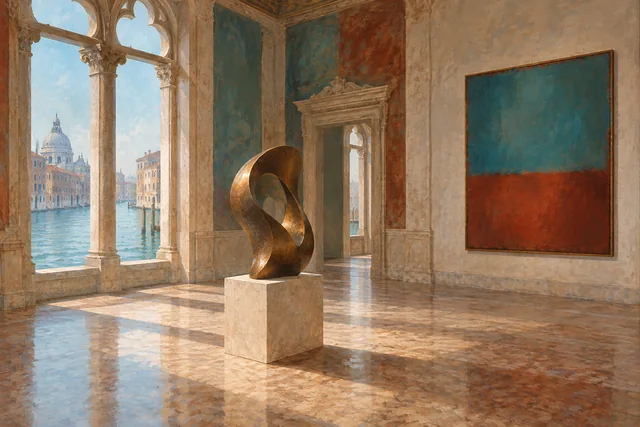
The foundation’s architecture section introduces the interventions that shape the modern visitor experience. Its account of Carlo Scarpa’s area emphasizes controlled water, stone, concrete and garden. Start with one junction between materials instead of trying to photograph the entire space at once.
Where does an edge change direction? How does a step, channel or opening guide your eye? Does reflected light make a solid surface seem different? These are observations available without technical training. They are also more useful than calling every unusual detail a symbol before you know what the architectural interpretation says.
Stay on the designated route and do not test surfaces or water features. A designed encounter with water is not evidence that every area remains accessible in all tide conditions. Our guide to Venice’s tide forecasts explains why current conditions and local instructions still matter.
Move from a detail to the whole route
After studying one material junction, notice how you arrived there. Did the route turn, narrow or open? Were you encouraged to pause before seeing the next space? Architecture can shape the pace of a visit as much as the appearance of a room. You can describe that experience without claiming to recover the architect’s exact intention.
For comparison, the Scala Contarini del Bovolo guide looks at movement and architecture in a very different Venetian setting. Neither visit needs to become a competition for the most impressive photograph. A remembered sequence of spaces can be a more personal record than another wide-angle view.
Give the collection its own questions
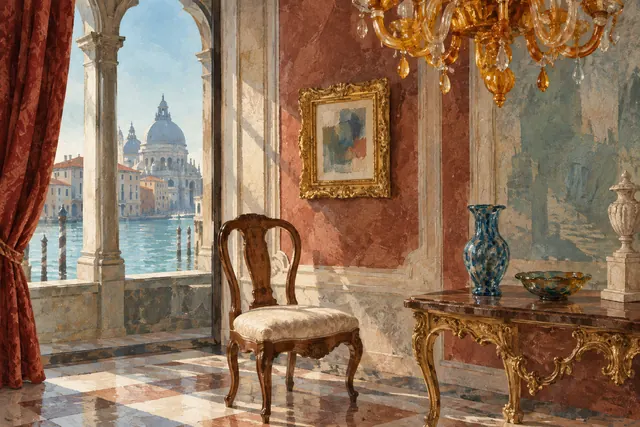
The foundation describes its collection through the former home and the family’s objects, while the current programme also changes how visitors encounter the building. Check the visit information and current exhibitions rather than assuming an old photograph represents today’s arrangement. A house museum is not necessarily an interior left untouched at one historical instant.
Choose a furnishing or artwork and ask what its interpretation documents. Was it made for this setting? When did it enter the collection? What does the label tell you about use, ownership or display? If an answer is absent, retain the question. The room’s atmosphere is not proof of every object’s original position.
Our Ca’ Rezzonico article provides another way to think about rooms and objects. On a wider Italy itinerary, Rome’s Galleria Spada offers a different architectural invitation to consider how looking is directed. These connections are tools for observation, not claims that the collections tell the same story.
Do not confuse late library opening with museum access
When checked on 15 October 2026, the official website advertised extended Thursday and Friday library hours. That notice concerned the library. The collections and exhibitions had a separate schedule, listed as Tuesday to Sunday, 10:00–18:00, with ticket sales ending at 17:30 and Monday closure. Recheck the relevant section for your date; a late library announcement does not extend every museum space.
Confirm tickets, accessible routes and any temporary limitations directly with the foundation. If you want to combine the visit with a guided activity, inspect the specific inclusions in Venice’s cultural experience collection. Leave room for a pause afterwards around Santa Maria Formosa. A successful visit can be quite compact: one material detail, one object history and a clearer sense of how a private inheritance became a place for public learning.
Sources & further reading
Turn a good read into a great day.
Find a highly rated Venetian experience that brings these stories to life.
Explore related experiences →