Ca’ Rezzonico in Venice: how do you read a room and its objects?

Ca’ Rezzonico offers a useful change of scale in Venice. After looking at palace façades from a canal or a bridge, you can spend time considering the relationship between rooms and objects. A chair, ceiling, painting and doorway all compete for attention. The enjoyable challenge is to see how they work together without assuming that every object has always occupied the place where the museum now displays it.
The museum is devoted to eighteenth-century Venice. Give yourself a modest theme instead of attempting to absorb every name and date: perhaps how a room creates ceremony, or how painted scenes differ from the space around them. Our Dorsoduro art-day guide can help you make one substantial collection the center of a manageable outing.
Begin with the room before the label
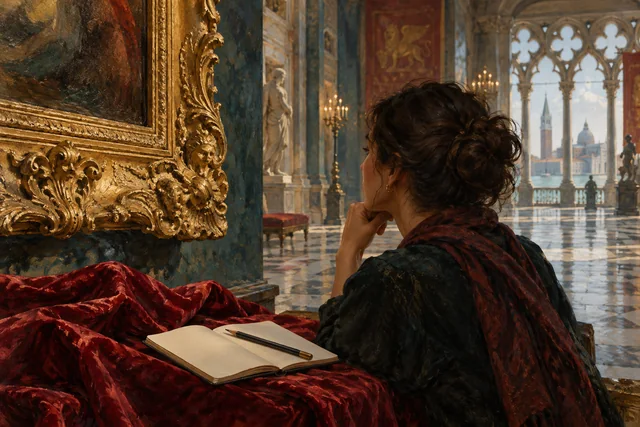
On entering a room, find a position that leaves the doorway clear. Look first at its proportions and the direction of the light. Where does your eye travel: toward a ceiling, through another doorway or across a group of furnishings? Then choose one object to examine. This sequence lets you experience a room as a space rather than as a row of captions attached to valuables.
The official museum route begins with Giorgio Massari’s ceremonial staircase and leads through first-floor rooms containing paintings, sculpture, furnishings and decorated ceilings. That range is the reason to slow down. You can learn something from the gap between a small object and a large architectural gesture without declaring that you have decoded the whole palace.
Distinguish a historic building from a museum arrangement
A palace museum brings several kinds of evidence into contact. The building has its own history; an object has a maker, date and previous life; the display has been arranged to help visitors understand a subject. When a label provides a former location, treat it as important information. A convincing-looking room is not, by itself, proof that everything in it belonged to the same household.
This matters particularly when works have been moved from elsewhere. The museum’s route identifies Giandomenico Tiepolo’s frescoes from Villa Zianigo among the second-floor highlights. Knowing that origin changes the question you ask. Instead of imagining them as decoration commissioned for the room around you, consider what you can learn from their subjects and from the explanation of their original setting.
Compare a painting with the view you know
Ca’ Rezzonico’s second floor also includes early works by Canaletto and a room devoted to Pietro Longhi. Choose one painting and spend a little time describing it before reading further: who is present, what activity is taking place, and what has the painter made easy to see? Description keeps your interpretation attached to the work rather than to a general idea of “old Venice.”
Our guide to looking at Venetian painting develops that habit. A picture can be a carefully constructed image rather than a transparent record of ordinary life. Notice selection, emphasis and viewpoint. It is perfectly reasonable to leave with an unanswered question if the evidence does not settle it.
Give furnishings a turn in the conversation
Paintings tend to collect most of the attention, so deliberately choose a piece of furniture or decorative object as your next stop. Look at the meeting of parts, the use of curves, and the contrast between a surface meant to be seen and one less visible. You can ask how an object suggests use while respecting barriers and never testing it by sitting, opening or touching.
For another material story, our Murano glass guide encourages looking beyond a dramatic demonstration. If your journey continues to Florence, the Pitti Palace introduction provides a different palace context. Compare ways of displaying objects rather than assuming the two institutions tell one interchangeable story.
Make a small plan and leave it adjustable
Check the museum’s current visitor information for the day you intend to come, including opening arrangements, ticket types and access needs. A combined museum ticket is only useful if its included places fit your actual schedule. A workshop or special visit may have separate booking conditions, even when a regular museum ticket is already in your pocket.
Browse our Venice art and cultural experiences if you would like a guide, checking precisely which collection the experience covers. Finish your own visit by returning mentally to one room and one object. Being able to explain what held your attention is a richer souvenir than remembering that you walked through every available doorway.
Sources & further reading
Turn a good read into a great day.
Find a highly rated Venetian experience that brings these stories to life.
Explore related experiences →