Venice’s Scala Contarini del Bovolo: what does an exterior staircase reveal?

A staircase is usually something you use on the way to somewhere else. Venice’s Scala Contarini del Bovolo asks you to look at the journey itself. Its curved tower, open arches and adjoining loggias turn movement between floors into an architectural display. The rooftop view may be the reason you first hear about it, but the structure offers plenty to notice before you climb a single step.
Let the name describe the shape
The site’s official history explains the association of bovolo with the spiral form. Pietro Contarini commissioned the staircase in 1499. The attribution of the design remains uncertain, with Giovanni Candi and Giorgio Spavento discussed as possibilities. That uncertainty is worth keeping: a confident name on a casual itinerary should not replace what the institution itself says about the evidence.
Stand where you can see both the cylindrical stair and the straighter lines beside it. Follow one curve with your eyes, then compare it with a horizontal arcade. The contrast makes the staircase readable as a separate object while tying it to the palace. You need not identify every stylistic influence to notice that combination. Begin with geometry, and let the historical explanation give it a setting.
Watch what the openings do
An enclosed stair hides most of the person moving through it. Here, repeated arches make the route visible in glimpses. Imagine following a visitor’s progress from one opening to the next, then look at the building again without anyone in view. The sequence of openings can suggest motion even when the staircase is still. This is an interpretation of the design, not proof of a particular ceremony once performed there.
Compare the warm brick with the pale stone elements. Color helps separate the wall surfaces from the arches and supports. A photograph can flatten those relationships, so take time to observe where one part projects in front of another. Our article on looking closely at a Venetian painting uses a related habit: describe the arrangement before reaching for an explanation. Architecture rewards the same patience.
Read the palace and staircase together
The official account places the older palace within the area between Rialto and San Marco and describes its earlier character as a casa-fontego, combining domestic and commercial functions. The staircase belongs to a later intervention in that setting. A building’s identity can therefore change without every part being replaced. Ask which relationships remain visible, rather than imagining that the entire complex appeared at once.
This is a useful comparison with Ca’ Rezzonico, where rooms and collections encourage another kind of architectural reading. At the Bovolo, circulation is especially prominent: the route between levels becomes something you can examine from outside. The point is not that every Venetian home had such a stair, but that this particular solution makes movement unusually legible.
Decide whether the climb suits your visit
The official visitor page describes a climb of eighty steps. Consider that as an actual physical part of the experience, rather than a small detail hidden behind a promised view. If stairs, balance or enclosed turning spaces are difficult for someone in your party, ask the venue about the available arrangements before purchasing. Do not assume that a viewpoint described as central is automatically easy to reach.
On the stair, keep the way clear and follow staff directions. Stop for a photograph only where doing so does not block others. At the top, spend a moment finding your bearings before naming distant buildings: a roofline may not look the way it does from a familiar street. Weather and the day’s operating conditions matter, so do not make an irreplaceable connection depend on a precisely timed rooftop stop.
Make the approach part of the looking
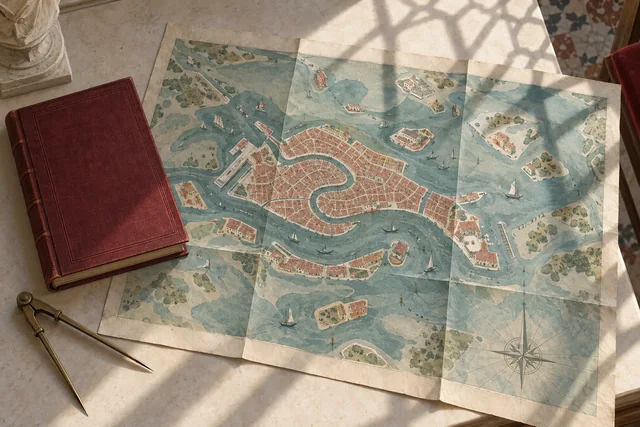
Use the venue’s current address and directions, then allow time for the final lanes on foot. Venice’s compact map does not eliminate turns, bridges or the need to check a doorway. Our neighborhood walking guide can help frame a broader outing, while walking experiences should be compared by their actual route and whether staircase admission is included.
For another Italian city’s approach to ascent, Florence Tour Hub’s bell tower and dome comparison makes a useful planning contrast. The structures and access rules differ; the shared question is whether the climb itself suits you. At the Bovolo, keep looking at the stair as you leave. The curve, repeated arches and connection to the palace may stay with you longer than the view you originally came to collect.
Sources & further reading
Turn a good read into a great day.
Find a highly rated Venetian experience that brings these stories to life.
Explore related experiences →