Venice’s Gesuati: how do you read a painted ceiling without losing the room?

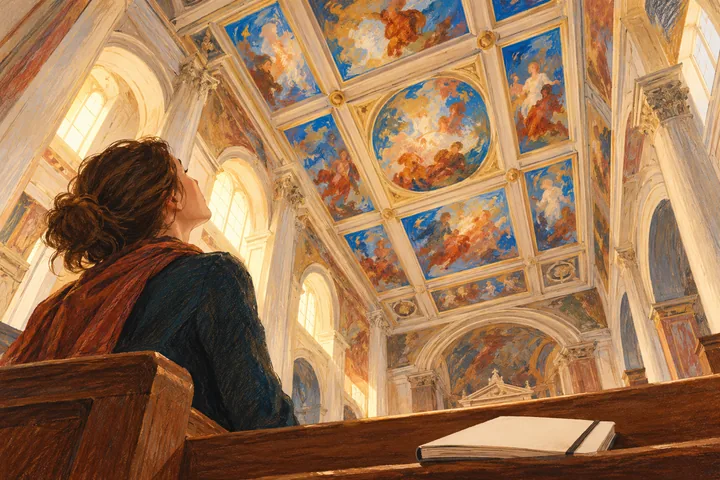
At the Gesuati, a ceiling can tempt you to spend the whole visit with your head tilted back. Give it a moment, then bring your gaze down again. Santa Maria del Rosario, on the Zattere, rewards an alternating rhythm: painting, architecture, painting, room. The aim is not to memorise every figure overhead. It is to notice how a decorative programme directs the attention of someone standing below it.
Get the name and setting straight
Chorus identifies the church as an eighteenth-century Dominican commission, built between 1726 and 1735 after the Dominicans succeeded the suppressed Gesuati community. The familiar name preserves that earlier association. It should not send you searching for the Gesuiti, a different Venetian church. Check the full name and the Zattere location when planning your route; similar-looking names can produce surprisingly long detours in a city of bridges.
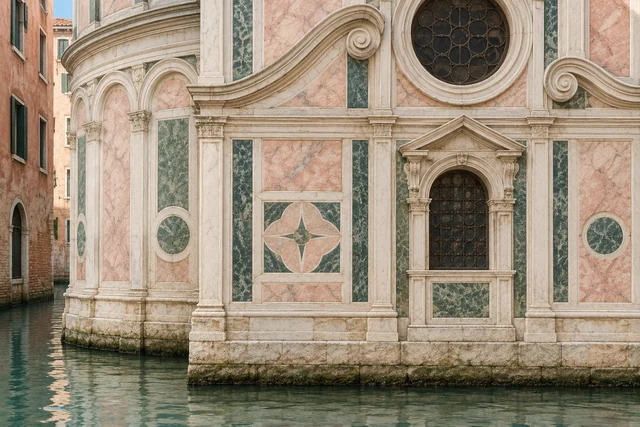
The church’s design is associated with Giorgio Massari, with contributions by artists including Giambattista Tiepolo and Gianmaria Morlaiter. That collaboration gives you a useful looking question: where do architectural divisions prepare a place for painting or sculpture? You need not treat the building as a container and the artworks as detachable highlights. The relationship between them can be the main subject of your visit.
Begin with the frame around the picture
Choose a comfortable permitted position and look at the boundary of one ceiling field. Notice how the surrounding architecture shapes your view before you try to identify the figures. Does a curve slow your eye? Does a pale border separate the painted space from the real one? These are your observations, not a claim that there is one correct viewing position for everyone.
Then take in the ceiling’s broader sequence. Chorus identifies three large fresco scenes by Tiepolo associated with the Virgin, Saint Dominic and the rosary. Read the on-site explanation to connect names with the scenes you can actually see. If distance or lighting makes a detail unclear, leave it unclear rather than enlarging a phone image until an uncertain shape becomes a confident identification.
Let your eyes come back to earth
After looking upward, lower your gaze to the room’s real depth. A painted expanse and an architectural opening create different kinds of space. Ask how one changes your response to the other. You might notice that a ceiling feels more expansive after your eye has registered the solidity of a wall or the repetition of structural elements. That is a useful personal observation, even without specialist terminology.
Our Scuola Grande dei Carmini guide offers a related exercise in the relationship between painting and ornament. The institutional setting differs, so resist treating the two interiors as interchangeable Tiepolo stops. Compare a particular effect instead: how a frame shapes attention, how colour works at a distance, or how a room encourages you to turn and look again.
Remember that this is a church
The works belong to a devotional setting, not simply an indoor gallery of celebrated names. If a service is taking place, give worshippers space and follow the staff’s instructions. A visit undertaken for art should not interrupt the activity for which the church exists. Keep conversation low, dress appropriately and check current photography rules before raising a camera.
Chorus’s current information distinguishes free entry to its churches from contributions for certain specific internal museum spaces. Do not rely on an old pass description to infer today’s arrangements everywhere. As checked on 24 October 2026, the Gesuati page lists artistic visits from Monday to Saturday and separately lists worship times. Check the current notice for your date; a service schedule does not automatically provide an art-visiting window.
Make a comparison outside
On leaving, pause safely on the waterfront rather than immediately checking the next pin on your phone. Looking across water after studying an overhead interior is a welcome change in scale. Our Redentore guide discusses another church’s relationship with its waterfront, while Santa Maria dei Miracoli provides a much smaller architectural comparison. Choose one, allowing for the actual route and bridges.
For a wider Italian art itinerary, Florence Tour Hub’s Brancacci Chapel guide considers painted narrative in a different space. Our Venice art experiences can help you compare guided visits, but only the stated itinerary establishes whether the Gesuati is included. A satisfying independent visit can be simpler: understand the setting, follow one painted sequence, and leave with a clearer sense of how the ceiling and the room work together.
Sources & further reading
Turn a good read into a great day.
Find a highly rated Venetian experience that brings these stories to life.
Explore related experiences →