Venice’s Museo Fortuny: how do you follow an artist’s experiments across materials?

Museo Fortuny rewards a question that sounds almost too simple: what happens when the same person keeps changing materials? A painting, a piece of cloth and an experiment with light can seem like unrelated museum objects. At this Venetian museum, try treating them as different ways of investigating how we see. You do not need technical knowledge of weaving or stage design to begin; curiosity about one surface is enough.
The museum occupies Palazzo Pesaro degli Orfei in Campo San Beneto. Its official presentation gives both Mariano Fortuny and Henriette Nigrin a place in the story of experimentation. That matters when looking at a celebrated creative name: read the account of collaboration rather than imagining every result emerged from a solitary flash of inspiration. The house offers an unusually rich setting for asking how ideas become things.
Start with a material, not a biography
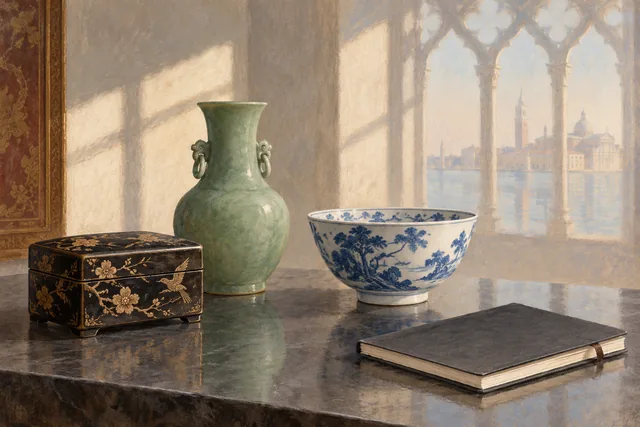
Choose one object that makes you slow down. Perhaps the attraction is a fold, a change in sheen or the way a light falls across a surface. Describe what you actually notice before deciding what the object means. A smooth area might appear brighter than a textured one, but that observation alone does not identify the manufacturing process. Let the label supply the technical detail.
This approach keeps a dense collection manageable. You can enjoy an object without having memorised its maker’s entire career. Our guide to looking closely at a Venetian painting offers a similar sequence: observe, ask a question, then read. At Fortuny, expand the method beyond the painted rectangle.
Follow an idea between different objects
The museum’s collection account connects artistic work with research and invention around the turn of the twentieth century. Use that connection as a prompt rather than a requirement to find a single master explanation. Two objects might share an interest in colour while answering very different practical needs. Similar appearance does not establish that they were designed together.
Try a small comparison: select a second object made from a different material and ask what has changed. Is light reflected, softened or blocked? Does the work invite you to look from one position or several? Keep these as your observations unless the interpretation confirms an intended effect. The enjoyable part is noticing how much a modest shift in viewpoint can reveal.
Remember that a room also frames the objects
Historic surroundings can make a museum feel intimate, but atmosphere is not a transcript of daily life. A contemporary display, a surviving room and an object once used there are different kinds of evidence. Notice which the museum is showing you. Do not assume that a photograph of an arrangement proves everything stood in precisely that place during the artists’ lifetimes.
For another approach to objects and dress, our Palazzo Mocenigo guide makes a useful companion. It helps separate an individual experiment from the wider social histories attached to clothing. Both visits can be rewarding without turning them into a race to identify the most famous garment.
Check the season before choosing your arrival time
The official visitor information checked on 22 October 2026 lists opening from 10:00 to 18:00 through 31 October, with last admission at 17:00. From 1 November to 31 March, the listed closing time is 17:00 and last entry 16:00. Tuesday is the regular closing day. Check current notices for exceptions, and allow time for the visit rather than arriving at the last admission.
Confirm the exhibition programme and ticket conditions separately. A museum’s collection, a temporary exhibition and a special evening opening need not share identical arrangements. Ask directly about the route if steps, standing time or lighting affect your visit; the mood of a promotional photograph cannot answer those access questions.
Leave with one experiment in mind
Afterwards, recall one object and one unresolved question before reviewing your photographs. For a different modern-art setting, consider Ca’ Pesaro on another day. If your journey continues to Milan, the Triennale design guide offers a further way to think about materials and use.
Our Venice experiences collection can help you compare guided cultural visits. Check the named stops and inclusions: a general art walk does not automatically include Fortuny. A focused museum visit succeeds when it sharpens your attention, even if you leave happily aware of how much remains to discover.
Sources & further reading
Turn a good read into a great day.
Find a highly rated Venetian experience that brings these stories to life.
Explore related experiences →