Venice’s Gallerie dell’Accademia: how can a first visit avoid painting overload?

The Gallerie dell’Accademia in Venice can be approached as a collection of famous names, but that is a tiring way to begin. A more satisfying first visit gives you a small number of questions and enough time to look. Choose contrasts: a landscape and a large gathering, a quiet face and an architectural setting. You are not trying to prove that you have seen every important painting. You are learning how this particular collection rewards attention.
Start with the correct museum and a modest plan
Venice’s Gallerie dell’Accademia are at Campo della Carità in Dorsoduro. Do not confuse them with Florence’s Galleria dell’Accademia when researching or booking. Similar names can send you to an entirely different city’s hours and admission page. Begin at the Venetian museum’s own website, then decide how much concentration your day realistically allows.
The official page checked on 30 October 2026 lists Tuesday-to-Sunday opening from 09:00 to 19:00, ticket sales ending at 18:00, and exit procedures beginning half an hour before closing. Full admission is listed at €15. The museum directs visitors to its calendar for variations and names TicketOne as its authorised online ticket seller. A ticket for a guided service should be read separately for its actual admission and meeting arrangements.
Give a smaller painting enough space
The museum’s Sala VIII interpretation places Giorgione’s The Tempest and La Vecchia within a discussion of his experiments with colour and his influence on Venetian painting. That provides a useful starting point without requiring you to master every proposed explanation of a picture. First look at relationships: light and dark, a figure and its surroundings, a face and the space beside it.
With a landscape, notice where your attention travels. Do you look first at a figure, a patch of light or the sky? What draws you back to an area you initially overlooked? Describe that movement before deciding what the whole image must mean. A personal observation is worthwhile when you identify it as your response, rather than presenting it as a settled historical interpretation.
Change scale, then change the question
The museum’s archived account of Convito di vetro identifies Veronese’s Feast in the House of Levi as a painting of 1573. A large multi-figure composition asks for a different viewing rhythm from a smaller painting. Where the room permits, begin far enough away to notice the overall structure, then move closer to examine selected details without obstructing other visitors.
Try following a line of architecture or a sequence of gestures. Which figures seem connected, and which occupy their own small episodes? You do not have to count every character. The comparison with a more intimate painting can teach you something about viewing itself: distance, scale and the number of competing details all affect the way your attention works.
Keep temporary displays in their own dates
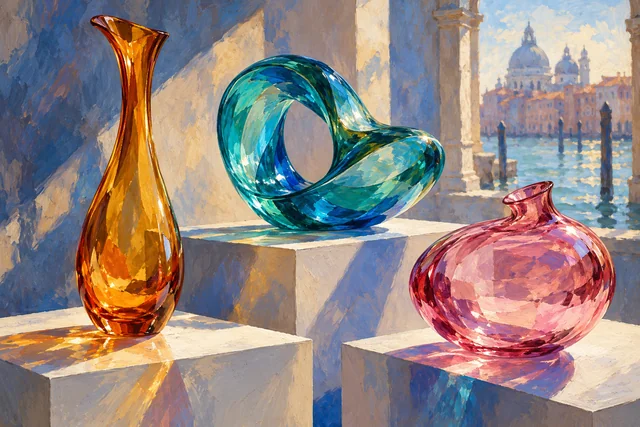
Search results can preserve an exhibition long after it ends. The museum’s Convito di vetro page, for example, describes a dialogue between glass objects and Veronese’s painting, but gives dates from 14 September to 3 November 2024. It is useful historical reading, not evidence that the same glass installation is available now. Check the dates attached to any special display before making it the reason for your trip.
The same discipline applies to individual works. Collection ownership does not guarantee that every object is visible on every visit. Loans, conservation and changing displays can affect what you encounter. If one painting or drawing is essential to you, ask the museum about current display rather than relying on a generic list of highlights. A flexible shortlist is usually more robust than a single-object ultimatum.
Build in a pause and an exit decision
After a few concentrated stops, check your attention rather than your progress through a checklist. If every label begins to blur together, pause where seating is available or decide that you have reached a good stopping point. Leaving with two paintings remembered clearly is preferable to completing more rooms without absorbing them. Save a question for another visit instead of treating unfinished looking as failure.
The museum lists free admission on 1 and 4 November 2026, with no reservations for those days and stated priority categories. Check its full conditions; free admission is not a guarantee of immediate entry. Our Dorsoduro planning guide helps you shape the surrounding day, while the Peggy Guggenheim Collection and Ca’ Pesaro offer different art collections. Browse Venice art experiences for the named venues included. Florence’s Uffizi guide continues the discussion of choosing a manageable museum visit. Keep your first Accademia afternoon focused enough to remain curious at the end.
Sources & further reading
Turn a good read into a great day.
Find a highly rated Venetian experience that brings these stories to life.
Explore related experiences →