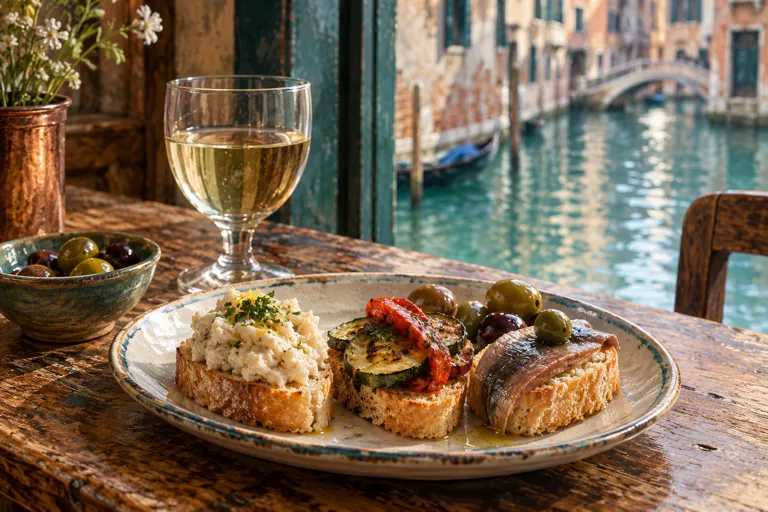
A Venetian Lunch: How to Read the Menu Without Rushing

A Venetian menu becomes easier to enjoy when you stop treating it as a test of local knowledge. You need a few useful distinctions, a sense of your appetite and permission to ask a clear question. A seated lunch is also a different proposition from a succession of cicchetti at a busy counter: it can give you time to understand one dish and let the morning’s sightseeing settle. Start with what sounds appealing, then investigate the ingredients and format before choosing.
Use the headings as a map, not a compulsory sequence
Antipasti introduces starters; primi usually includes dishes such as pasta, rice or soup; secondi covers main dishes, often fish or meat; contorni means side dishes. These sections organize possibilities. They do not oblige every diner to eat their way through the entire menu. One satisfying main dish with a side, or a starter followed by a first course, may fit your day perfectly.
Ask how substantial a portion is if that will influence your choice. Also clarify whether an accompaniment is included or ordered separately. “We would like a light lunch before a museum visit” gives staff more useful information than a vague request for something typical. It invites a recommendation that suits your appetite and schedule instead of a performance of everything the kitchen can produce.
Let one dish introduce a wider food story
The city’s guide to Venetian culinary traditions describes sarde in saor as fried sardines marinated with vinegar, onions, raisins and pine nuts. Its combination of savory, sweet and acidic flavors offers more to consider than the label “fish starter.” Ask how the kitchen prepares its version rather than assuming every plate will be identical.
The same source explains risi e bisi, rice and peas, as sitting between risotto and a thick soup, and identifies risotto di gò with a small lagoon fish. These are useful menu terms, not promises that every restaurant serves them every day. If you see an unfamiliar dish, asking what its main ingredient is will usually tell you more than searching for a literal translation of every word.
Read the region as well as the city
A Venice menu may draw on the wider Veneto, whose food landscape stretches far beyond the lagoon. Italy’s official tourism portal describes regional foods including polenta, radicchio and different local rice and fish dishes. It is helpful to keep those places distinct. Something can belong to the regional kitchen without having originated in the historic center of Venice.
Try asking which vegetable is particularly good now, or which dish the kitchen most enjoys preparing. Seasonal curiosity is more productive than demanding a fixed list of famous dishes regardless of the date. Our Rialto market guide offers a way to connect those questions with the ingredients you may have noticed earlier in the day. Treat the market as context, not proof of where a particular restaurant buys its food.
Make the practical questions comfortable
Read prices and any notes before ordering. For a dish quoted by weight, ask about the intended portion and total; for a special described aloud, ask its price as naturally as you ask what accompanies it. Check any stated cover or service charge and the cost of drinks. These are ordinary ordering questions, and resolving them early keeps the meal relaxed.
Tell staff about dietary requirements directly and ask about the actual preparation. A vegetable dish may contain stock, butter or other ingredients you cannot see, while a familiar recipe name does not guarantee a particular version. If avoiding an ingredient is essential, rely on a clear answer from the kitchen rather than a guess from the appearance of a plate. For a booked dining experience, confirm arrangements with the operator before paying.
Choose the lunch format that serves your afternoon
On a day with a fixed departure or museum slot, pick a restaurant near the next stop and state your time limit before sitting down. If your schedule is open, protect the meal from unnecessary appointments. A relaxed lunch is less about stretching every course than knowing you are free to finish without repeatedly checking the clock.
If you would rather taste several small things while moving between places, our cicchetti guide explains that alternative. Our Venice dining collection also includes different experience formats; compare seated time, tastings, drinks and walking before deciding whether an outing will replace lunch or merely precede it. A cooking class and a tasting walk solve quite different appetites.
Before leaving the table, write down the name of one dish you liked and a detail that made it memorable: the softness of onions, the texture of rice or the balance of acidity and sweetness. You have learned something useful without trying to become an expert in one sitting. Let the rest of your Venice day keep a little of that same unhurried attention.
If Rome follows Venice on your itinerary, our sibling guide to what to eat in Rome beyond pasta offers a useful change of regional focus. Keep asking about ingredients and preparation instead of assuming that a familiar menu heading promises the same dish in every city.
Sources & further reading
Turn a good read into a great day.
Find a highly rated Venetian experience that brings these stories to life.
Explore related experiences →